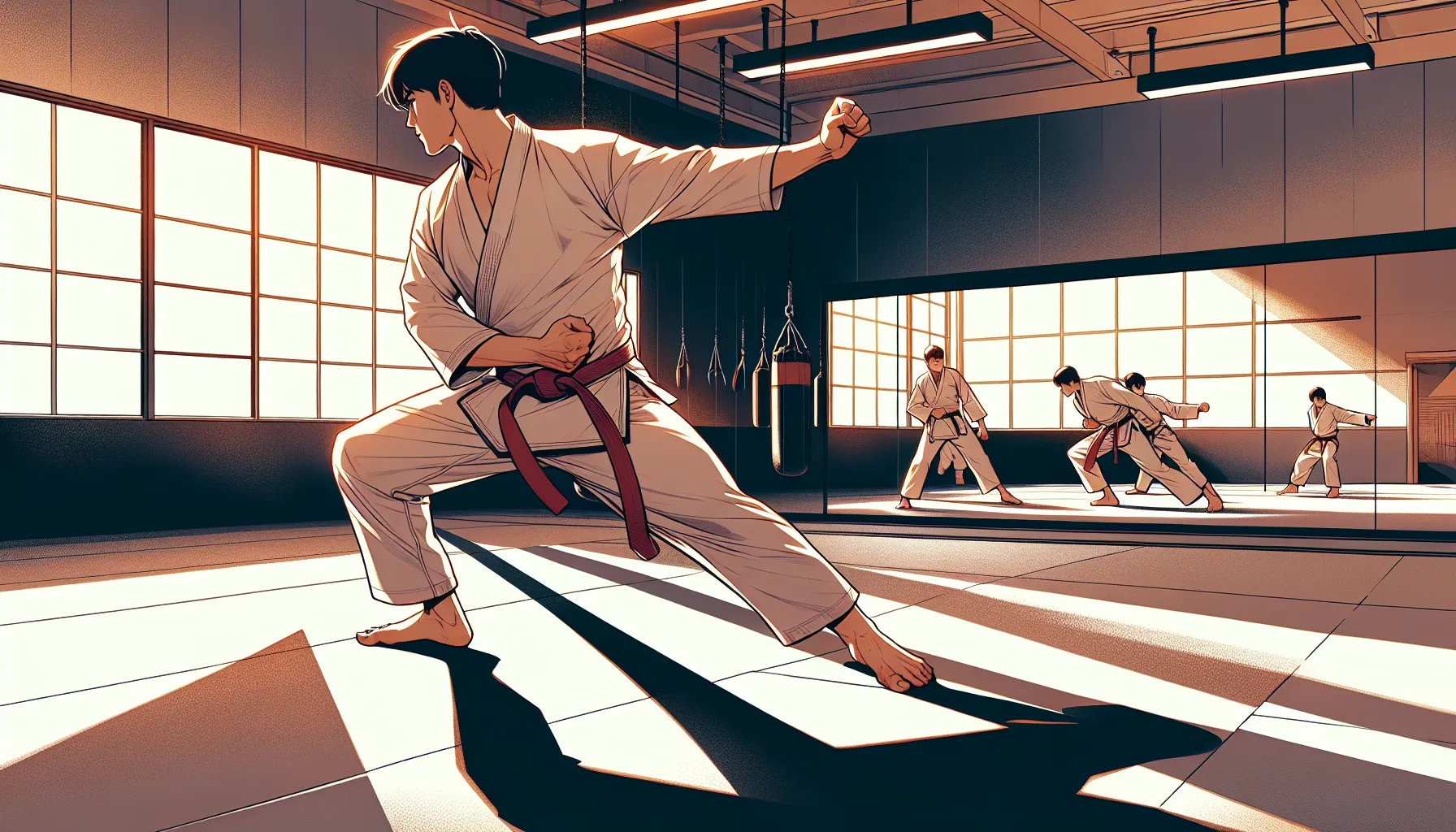
Zen Do Kai integrates rather than collects. Karate supplies structure and stance, Muay Thai the clinch and low kicks, Krav Maga the response to genuine threat, jiu-jitsu the ground. They are taught as one system with shared principles, not as separate modules bolted onto a karate base.
There is a common failure mode in "freestyle" or "mixed" martial arts teaching. An instructor trained primarily in karate decides to broaden their offering. They add some grappling drills they saw on YouTube, a few Muay Thai combinations, and some terminology borrowed from Krav Maga. They call it "mixed martial arts" or "freestyle."
What they have produced is a poorly integrated collection of disconnected techniques from systems they do not deeply understand. It is not integration. It is decoration.
The Zen Do Kai BJMA system is different, and the difference matters.
What separates integration from decoration?
The distinction between integration and decoration comes down to whether the practitioner understands the underlying principles of the systems they are drawing from.
Every effective martial art is built around principles, not just techniques. Karate is built around principles of structure, linear power generation, and the use of distance. Muay Thai is built around principles of attrition, the use of hard natural weapons (knees, elbows, shins), and clinch work. Krav Maga is built around principles of aggression under threat, neutralisation of danger as fast as possible, and awareness of the tactical situation. Jiu-jitsu is built around principles of leverage, position, and the submission of a larger opponent.
When you understand these principles, you can identify which elements of each system genuinely serve a self-defence curriculum and how they connect to each other. When you do not, you collect techniques and hope they add up to something.
Bob Jones, who founded the BJMA Zen Do Kai system, had trained deeply enough across multiple systems to understand the principles. The techniques he incorporated were not chosen because they looked impressive. They were chosen because they passed a test: do they work under pressure in a realistic encounter, and do they integrate coherently with the rest of the system?
What Karate Contributes
Karate brings several things to the Zen Do Kai system that other disciplines do not provide as cleanly.
The first is structure. The karate tradition has developed rigorous attention to physical structure: how to stand, how to generate power from the ground up, how to align the body for maximum force transfer. These structural principles underpin effective striking in any style, whether you call it karate or not.
The second is distance management. Traditional karate practitioners develop a very precise sense of the distance from which a given technique is effective. That spatial awareness is valuable across all ranges of fighting and transfers to the broader system.
The third is the discipline of form. Karate's kata tradition, whatever its limitations as a combat training method, produces practitioners who have executed fundamental techniques thousands of times with attention to precision. That depth of repetition builds motor patterns that persist under stress in ways that a lighter approach does not.
The Zen Do Kai curriculum takes these contributions from karate and uses them as a foundation for everything else.
What Muay Thai and Krav Maga Contribute
Muay Thai's great contribution is the use of the whole body as a weapon. Most striking systems focus primarily on punches and kicks. Muay Thai develops the knee, the elbow, the shin, and the clinch position as equally important tools. This matters in close quarters, where punching range collapses and a practitioner with only punches and long kicks is suddenly running out of options.
The Zen Do Kai curriculum incorporates Muay Thai principles particularly in the clinch and in close-range striking. The elbow and knee techniques that Muay Thai has refined over centuries address the gap that opening ranges creates in a primarily karate-based striking system.
Krav Maga contributes primarily a tactical and psychological mindset. Krav Maga was developed for military and security contexts where the priority is not a clean fight but a fast, decisive resolution of a threat. Its emphasis on aggression under pressure, on dealing with weapons, and on awareness of the tactical situation (multiple attackers, environmental obstacles) broadens the self-defence curriculum beyond the one-on-one standing encounter that traditional martial arts typically assume.
The Zen Do Kai curriculum does not adopt Krav Maga's specific techniques wholesale. What it takes is the mindset: that self-defence means dealing with real-world situations as they actually occur, not idealised combat scenarios.
What Jiu-Jitsu Contributes
Every complete martial artist needs to understand what happens when the encounter goes to the ground. Jiu-jitsu, particularly Brazilian jiu-jitsu in its modern form, has developed the most sophisticated ground-based grappling system available.
The Zen Do Kai curriculum incorporates jiu-jitsu principles in its ground work, with a specific emphasis on the self-defence application rather than the sport application. The priority in a real encounter is not to submit an opponent on the ground, because the ground is a dangerous place when there may be other threats, hard surfaces, and no referee to enforce tapping. The priority is to control and escape.
Students learn ground positioning, escapes, and the basic controls from jiu-jitsu that make the ground manageable. They also learn the principles of why ground work is dangerous in a real encounter, why getting back to standing should generally be the priority, and how to make that transition while maintaining safety.
The Integration That Makes It Work
What makes Zen Do Kai more than the sum of these parts is the explicit work done on transitions between ranges.
Most encounters do not stay in a single range. They begin at distance, close to striking range, transition to clinch, may go to the ground, and may return to standing. A practitioner trained in only one range is well-prepared for only one phase of what may be a multi-phase encounter.
The Zen Do Kai curriculum drills the transitions. Students learn not just how to strike and not just how to grapple, but how to move between them: how to tie up a striking attack and transition to a takedown, how to create distance from a clinch and return to striking range, how to get back to standing from a disadvantaged ground position.
This is the hardest part of the curriculum to develop and the part that most clearly separates a genuinely integrated system from a decorated one. It requires instructors who understand all the ranges they are teaching between. Shihan Nick Putt, with 35 years in the BJMA system, brings exactly that understanding to his teaching at Inception Academy.
Complete, Not Complicated
One more thing is worth saying. A complete system does not mean a complicated system. The goal is not to produce students who have memorised thousands of techniques from multiple disciplines. The goal is to produce students who have sound principles, effective fundamental skills across the relevant ranges, and the adaptability to respond to what actually happens.
Complexity for its own sake is a training liability, not an asset. Under stress, the brain does not access complex repertoires reliably. It accesses simple, deeply ingrained patterns. The Zen Do Kai curriculum prioritises quality of fundamental skills across all ranges over the accumulation of exotic techniques from any single tradition.
That is what a complete fighter looks like: not a walking encyclopaedia of techniques, but a practitioner who is dangerous and adaptable across the full range of real encounters.
If you want to see integrated, complete martial arts training in action, book a free trial at Inception Academy. Come and watch what 35 years of BJMA Zen Do Kai looks like.
For a detailed look at how our curriculum is structured and what students learn at each stage, visit our Zen Do Kai curriculum page.