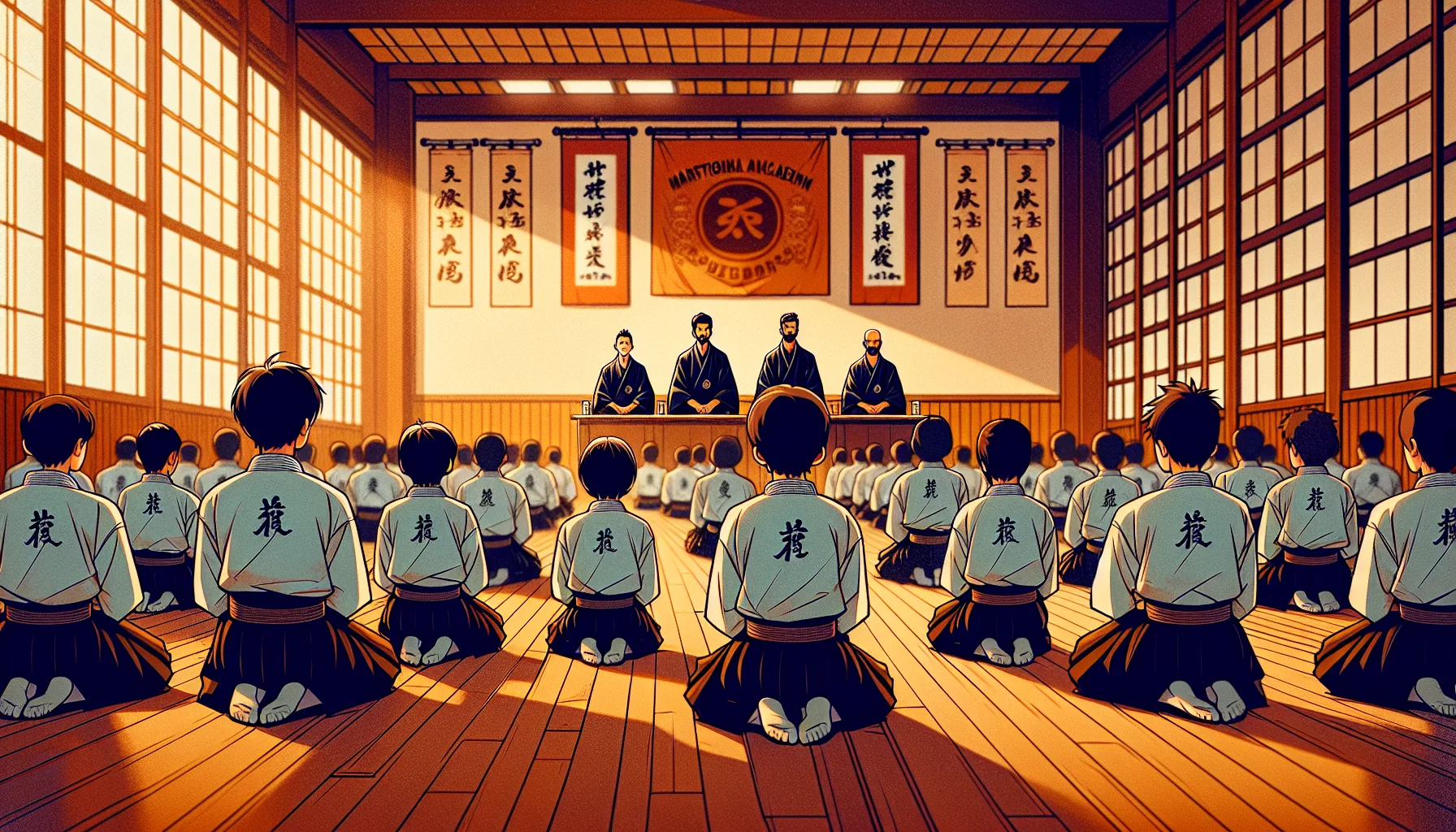
Belts at IAMA map to twelve psychological attributes, from Calmness at white through to Altruism at black. Rank cannot be bought or aged into; it is assessed against a BJMA standard and can be failed. The belt records what a student has demonstrated, not what they paid for.
The coloured belt is one of the most recognisable symbols in martial arts. It is also one of the most misunderstood.
To people outside the dojo, belts are trophies, visible markers of status in a colour-coded hierarchy. To McDojos, they are revenue, scheduled out at three-month intervals and priced accordingly. To a real dojo, a belt is something altogether different. It is evidence. Evidence that a specific set of skills has been developed, a specific set of attributes has been demonstrated, and that a student is genuinely ready to take on the next level of challenge.
That difference, between a belt as a trophy and a belt as evidence, makes the belt system either a developmental tool or a participation ribbon system for older children.
Where did the belt system come from?
The coloured belt system as most people know it today is relatively modern. Jigoro Kano introduced belt ranks in judo in the late 19th century as a way of indicating training progression. The colour system we are familiar with, from white through to black, was developed in the 20th century and adopted across most major systems.
The original purpose was practical: it allowed instructors to match training partners appropriately and gave students a clear map of where they were in their development. Neither of those functions has changed. What has been added, in systems like the one we practise at Inception Academy, is an explicit psychological framework mapped onto the physical progression.
The 12 Values and How They Map to Progression
At Inception Academy, we train within the Zen Do Kai Freestyle system under the BJMA framework. Belt progression is structured around 12 psychological attributes, each one introduced at a specific point in the belt journey for a specific developmental reason.
White Belt: Calmness. Every student begins here, regardless of age or prior experience. Calmness is first not because it is easiest, but because nothing else is possible without it. A student who cannot regulate their nervous system cannot learn new techniques, receive correction, or respond to a training partner appropriately. The first weeks of training are, at one level, a course in physiological self-regulation. Breathing, stillness, the management of arousal in a physically demanding context.
Yellow Belt: Awareness. Once a student can be calm, they become available for accurate perception. Awareness in the martial arts context means something specific: awareness of your own body and its tendencies, awareness of the space around you, awareness of the person you are training with. It is active, attentive perception, not passive observation. Yellow belt students are learning to actually see what is in front of them.
Orange Belt: Perseverance. The introduction of perseverance at orange belt is carefully timed. By this stage, students have developed enough foundation to encounter real difficulty. A technique that will not click. A partner who is faster or more technically proficient. The gap between where you are and where the next grading requires you to be. Perseverance is introduced as an explicit value at precisely the point when students need it most.
Green Belt: Self-Efficacy. Self-efficacy is not self-esteem, and the distinction matters. Self-esteem is what you feel about yourself; self-efficacy is your belief in your capacity to produce specific outcomes through your own effort. Green belt students have accumulated enough successful experiences in the dojo to begin developing genuine self-efficacy. They know, from direct experience, that sustained effort produces real improvement.
Blue Belt: Self-Regulation. By blue belt, students are in genuinely complex training. The techniques require more coordination, more speed, more precision. The ability to manage your own emotional and physiological responses under pressure becomes increasingly important. Self-regulation at this stage is about staying constructive when things go wrong, holding quality under fatigue, and continuing to engage with difficulty without shutting down or becoming reactive.
Purple Belt: Respect. Respect appears at the midpoint of the belt journey deliberately. Earlier, students experience the dojo's culture of respect as something that is required of them from outside. By purple belt, they have been in the dojo long enough to have developed genuine respect from the inside: for their instructors who have guided them, for their training partners who have challenged them, for the system that has produced the improvements they have experienced directly.
Brown Belt 1st Tip: Integrity. Integrity in the dojo means doing what is required when no one is watching. Training honestly when you could cut corners. Being accurate about what you can and cannot do. Not pretending. By first-tip brown, students are senior enough to be watched by juniors, which adds a new dimension to the practice of integrity. What you model matters.
Brown Belt 2nd Tip: Courage. Physical courage in martial arts training is well understood. The courage to take the impact, to step forward when instinct says step back. But there is also the less visible courage: speaking up when something is wrong, attempting a technique you are not confident in, asking for help. Brown belt students encounter both forms.
Brown Belt 3rd Tip: Humility. Humility at this stage of the belt journey requires real maturity. Brown belts are senior students. Junior students look up to them. It would be easy to let seniority become arrogance. Humility is deliberately placed here as a counterbalance, as a reminder that skill in the dojo reflects practice time and good instruction, not personal superiority.
Brown Belt 4th Tip: Discipline. Discipline at fourth-tip brown is not the external discipline of following instructions. It is internal discipline, the capacity to direct yourself without requiring external management. Students at this level are expected to be self-directed in their training, to notice their own gaps and address them, to come to class ready to work without prompting.
Brown Belt 5th Tip: Compassion. Senior students interact extensively with junior students. Compassion is the value that governs those interactions. Not softness, not lowered expectations, but genuine care for the development of the junior student. The ability to see where someone else is, and meet them there.
Black Belt: Altruism. Altruism as the summit of the belt journey is a deliberate statement about what black belt means. It is not a claim of mastery. It is a commitment to service. A black belt in this system is someone whose development has been partly funded by the dojo community, and who now owes that community their best efforts in return.
Why Grading Is Earned, Not Scheduled
The belt progression I have just described only works if the grading is real.
At Inception Academy, students are graded when they are ready, not on a calendar schedule. The assessment covers technical execution, but also the psychological attributes associated with the belt being attempted. You cannot pass a grading by faking calm or performing respect. The training either shows up or it does not.
This means some students move faster than others. Some students need extra time at a particular belt because the associated attribute, perseverance, say, or self-regulation, is genuinely underdeveloped and the training is doing real work. Others develop quickly and grade accordingly.
The variability is a feature, not a flaw. It means that every belt is the real thing.
What the Belt Actually Means to the Child
Children are not naive about this. Most children who train in any structured context develop an accurate sense of what is earned and what is given. When a belt is genuinely earned, through months of effort, through a grading that required real preparation, the pride a child feels is qualitatively different from the pride of receiving a participation trophy.
They know it is real. That knowledge is the developmental payload.
When a child who has worked for six months finally earns their next rank, they are not just receiving a new colour of fabric. They are receiving confirmation of something they already suspected: that sustained effort in the face of difficulty produces real change. That they are capable of more than they thought. That the gap between where they were and where they are now was bridged by their own effort.
That confirmation, repeated across years of belt progression, is what builds character.
Curious about where your child would start, or what the full belt journey looks like in practice? Book a free trial at Inception Academy and talk to us directly. We are happy to walk you through the curriculum and answer every question you have.
For the full picture of the values framework, read more about the 12 psychological attributes we develop from white belt to black.