Week one your child will be quiet and a little lost, which is normal. Week two they learn the routines. By week four most are correcting themselves. Bring a water bottle and comfortable clothes; the gi comes later. The first four weeks are free, so nothing is committed yet.
Starting something new is hard, even when you chose it and even when you want it. This is true for adults and it is especially true for children. The first few weeks of anything new involve real cognitive and emotional load: learning the rules of a new environment, reading new social dynamics, managing the uncertainty of not yet knowing what comes next.
I want to give new families at Inception Academy a realistic picture of what that first month typically looks like. Not a highlights reel, not a guarantee, but an honest account of the normal arc so that when the moments that surprise or concern you arrive, you have context for them.
What should you do before the first session?
A few practical things that help.
Talk to your child about what to expect without over-scripting it. "You are going to learn some techniques, line up with the other students, and follow the instructor's direction" is useful. "You will love it and it will be brilliant" sets expectations that the reality cannot always meet in the first session.
If your child is anxious about new environments, being as concrete and predictable as possible helps. The address, what the room looks like, what they will wear, what will happen in sequence. Predictability reduces anticipatory anxiety.
If your child has a neurodivergent profile, mention it to us before the first session. Not because it changes what we teach, but because knowing that a child is likely to struggle with transitions or has sensory sensitivities or needs slightly different pacing allows the instructor to set them up for success rather than discover these things after the child has already had a difficult experience.
Come a few minutes early for the first session. Arriving when the class has already started adds to the anxiety load. Arriving before the session begins allows your child to observe the environment briefly before they are in it.
The First Session
For most children, the dominant emotion in the first session is a mixture of excitement and self-consciousness. They are in a new place with new people and they do not yet know the rules. This is manageable for most, but it produces a particular quality of attention: narrowed, cautious, very focused on what everyone else is doing rather than on absorbing instruction.
This is normal, and it is worth knowing because it means the first session often does not produce the transformation parents expect. The child who asked keenly to start martial arts may come out of the first class looking subdued. Ask them what they noticed. Ask what they found interesting. Ask what they were wondering. Open questions produce more useful information than "did you love it?"
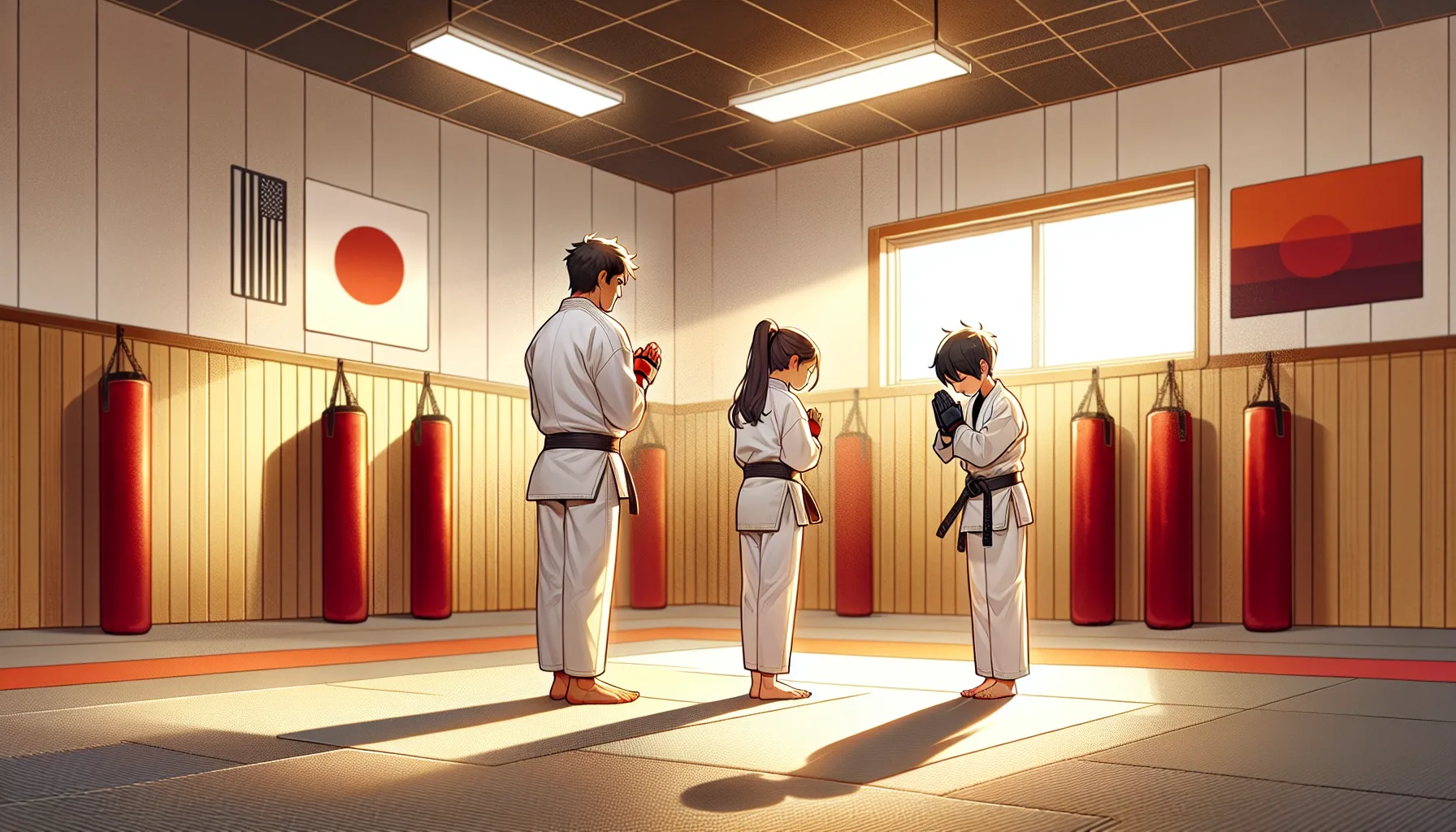
What happens in the first session technically: a bow-in, a warm-up, some foundational movement drills, a simple technique introduction, and a bow-out. The curriculum is deliberately accessible at the beginning. We are not trying to overwhelm new students with the depth of what is to come. We are establishing the basic framework: the structure, the tone, the social contract of the dojo.
For children with ADHD or anxiety, the first session may involve more visible regulation effort than for other children. You may see fidgeting while waiting in line, some difficulty staying with the group's pace, or a short period of overwhelm. These are not signs the programme is wrong for your child. They are the predictable beginning of the adaptation process.
Week Two
The second session typically produces a different quality of engagement than the first, for most children. The environment is less novel: they know approximately what will happen, they recognise the space, they have a slightly clearer picture of what is expected. This familiarity reduces the cognitive overhead of simply being there, and frees up attention for actual learning.
This is often the week when you hear specific things from your child about what they are working on. They may come home and show you something. They may have a question about a technique or about why something is done a particular way. This is engagement, and it is worth responding to with genuine curiosity rather than enthusiasm that outpaces theirs.
Some children have their first experience of frustration in the second week. They tried something and it did not work the way they wanted. Or a technique they thought they had managed in session one is not landing cleanly in session two. This is developmentally useful, but it does not always feel that way in the moment.
The values curriculum introduces Calmness at white belt precisely because this kind of frustration is predictable and early. We name it. We talk about it. We give children a framework for making sense of the gap between wanting to be able to do something and being able to do it. You can reinforce this at home: "That gap between where you are and where you want to be, that is exactly where training happens. The frustration means it is real."
Week Three
By the third session, most children have the basic structure of the class internalised. They know the bow-in sequence, they know approximately what a warm-up involves, they have a sense of who the other students are. The social environment is beginning to feel less threatening and more familiar.
This is often the week when you start to see children paying more attention to the other students: noticing who is at which level, watching how the more advanced students move, beginning to form the social comparisons that motivate development. This is healthy. The presence of more advanced students in the dojo is a feature of the environment, not a problem. Seeing what is possible is motivating in a way abstract descriptions of "where you'll get to" are not.
Some children also begin to show their character more in week three. The child who is perfectionistic may become more visibly upset when something is not right. The child with ADHD may have had their initial enthusiasm plateau and be testing whether the structure that felt helpful in week one still holds. The child with anxiety may be comfortable enough to start showing more of their personality, including the more challenging parts of it.
These are good signs, even when they do not feel like it. A child who is comfortable enough to show their full self is a child who is settling in.
Week Four
By the fourth session, you are beginning to see the early pattern of what training is going to be like for your child. The novelty has worn off enough to reveal what their authentic engagement is. Some children are clearly thriving: they bounce into sessions, they talk about it at home, they practise techniques in the lounge. Some children are doing something quieter but equally real: showing up, working, improving, even if it has not yet become the highlight of their week.
Some children also hit a resistance point around week three or four. The excitement of starting something new has faded and the actual work of consistent training has not yet produced the clearly visible results that will come later. You may hear "I don't want to go tonight."
This is the point where parental response matters most. More on this below.
What your child has typically learned technically in the first four weeks, depending on age and class level: foundational stances, basic striking techniques, the class protocols and bow-in sequence, and the beginning of their first belt curriculum. The technical content is accessible but real. They are not just playing at martial arts. They have begun.
The Resistance Point
The "I don't want to go" moment deserves its own section because how you handle it has real consequences.
Most children hit some version of this. Some hit it in week two. Some hit it in month three. A few never hit it. For the majority, there is a point where the initial motivation is not enough to overcome the activation cost of going, and the new routine has not yet become habitual enough to run on its own momentum.
The research on habit formation suggests that the period between starting a new behaviour and that behaviour becoming self-sustaining is typically six to twelve weeks of consistent practice. You are often in that window during the first month.
My advice: do not make attendance negotiable while you are in this window. Not in a coercive way, but in the way that school attendance is not negotiable. "We go to training. You might not feel like it, and that is okay, but we go. Let us talk about what was hard about it after."
The distinction to observe is between "I don't want to go" as low-motivation resistance, which is normal and does not warrant stopping, and "I don't want to go" as a specific, articulable concern about the environment: a student who is unkind, a drill that feels overwhelming, something in the class structure that is genuinely not working. The first is normal. The second is information worth taking seriously and bringing to the instructor.
What Parents Can Do
A few practical suggestions for getting the most from the first month.
Come consistently. Two sessions per week is the programme. Irregular attendance during the settling-in period makes the settling-in period longer.
Arrive on time. Late arrivals add social and logistical stress for the child and interrupt the class. The bow-in sequence is structured for a reason.
Stay for the class if you can, especially in the early weeks. Your presence is regulating for younger children and it allows you to have specific conversations with your child about what you both observed. "I noticed you really got that kick combination right in the third set. What changed?"
Ask the instructor for feedback after sessions. We want to hear about your child, and early in the relationship we are watching carefully and have observations worth sharing.
Make the connection to the psychological discipline framework explicit at home. When you see your child managing frustration on the mat, name it. When you see them practising a technique on their own, connect it to perseverance. The values curriculum at Inception Academy works best when it extends beyond the dojo.
What to Expect from Us
We will know your child's name from the first session. We will be watching them. When they get something right, we will say so specifically. When they need a correction, we will give it clearly and kindly. If there is something we notice that you should know about, we will tell you.
We are not interested in producing uniform, unchallenging classes that everyone passes through. We are interested in genuine development, which means every child will face genuine challenge and every child will have genuine wins.
The first month is the beginning of a relationship between your child, the dojo, and us. It is worth investing in carefully.
If you are considering starting and want to see what the first session actually looks like, book a free trial. Come with your child. Watch and experience the environment before you decide.